Today we're giving blood. It's been really hard to encourage anyone to join me from my neighbouring businesses. Kinda made me think about my own experiences from before I was a donor...
The first time I gave blood, I was scared out of my wits!
I didn't like needles, I'd never faced blood loss over a pin prick full, and frankly, didn't like the idea at all.
Previously, I thought "Why on earth should I let someone stick a needle in my arm, and take something like a pint of my blood? It's gross, it hurts, and frankly, it's not me."
Then, one evening, whilst watching TV, I saw the work of a hospital team, fighting to save the life of someone my own age. He was quite a mess. Pretty much touch and go. He'd lost a lot of blood.
But it's ok, right? You make your own blood, so he can replace it.
Wrong.
So extensive were his injuries and blood loss that blood needed to be provided, and quickly. He was going into a condition called 'shock'. His organs were shutting down, and the result of this is death.
Blood was placed directly inside him from a supply. At the end of the program, there was information on who to contact for blood donation - and I made the call.
That program made me think long and hard about the fears I had about donating.
I was a regular donor from then on in, primarily in Germany where I was based as a soldier, but, if the time frame was right, when I was in the UK, and met the criteria, I'd share a pint with the NHS Blood Service.
Wales, England and Germany have all had a bit of my O+!
Some years on, and coming back to the UK, it is without hesitation that I'll give my blood.
Rarely now whole blood is used, unless it's to replace lost blood. The Blood Service collects the blood, and splits it down as required -
so that's Red Cells, used for conditions such as anaemia, as well as to replace lost cells after an accident, or childbirth.
Platelets which are vital for patients being treated for cancer.
Plasma which is really important for many uses, including the treatment of people suffering from Haemophilia.
In some countries I've visited, before certain interactions are taken at hospital level - a check is made for insurance, or the ability to pay for treatment.
In the UK, this isn't the case. It doesn't matter what colour or creed you are, whether you are wealthy or poor, you will receive the same level of treatment from expert staff, committed to going above and beyond to save your life, and give you the best prospects for recovery.
The NHS Blood Service forma a very real part of this chain, and rely upon people to give their own blood to save others. It is a great gift, and, you don't have to look far to find someone who is alive today, thanks to every person in the system, from the donors giving time and blood, the WRVS and other voluntary sector people, the Nurses and Support Staff, the Lab staff, all the way through to the Practitioners holding the giving set.
So why give? If for no other reason than I'm giving into a system that will gladly give me blood if I need it, no matter if I'm a paid up member of the club or not.
But more than that, the sense that you are making a difference to the lives of others - in fact, the knowledge that you are, goes far beyond any reward that can be received in monetary value.
When I first donated, I received a small card book, with pages that would get stuck in... things have changed, and Plastic cards are now issued, denoting the progress of your donation level. Mine are sadly low - as most my blood has been given overseas - but I'm working on changing that!
So how do my experiences bare against my fears in the 90's when I first donated?
I couldn't have been more wrong.
The needles - well, just don't look at them. The staff are so good, you'll hardly feel it. The investment of about a pint, again, is hardly noticeable, and, with a couple of moments of rest after donating, some cookies, and a drink, you're right as rain!
Blood donation has come on a long way - even in the last 10 years. The new trailer I was in today had all the advancements of technology.
What's more, donating blood is now so me, and I encourage anyone, and everyone to be the same. One day, it could be you that needs it back!
For more information:
In England: www.blood.co.uk
In Wales: www.welsh-blood.org.uk
In Scotland: www.scotblood.co.uk
In NI: www.nibts.org
This blog post has been written by Centric First Aid Training ( www.centricuk.com ) however may not reflect the opinions or views of the company, and is no way authored or a direct message from the NHS. Information is presented as is, and no responsibility is taken by either party for incorrect data. It is produced a opinion of an individual of their own personal experiences.
Friday, 16 January 2015

Thursday, 15 January 2015
Stomach upsets due to stress, bereavement, or an emotional event.
Quite recently (today in fact) I experienced a very traumatic event. One which I've experienced before, far too many times.
Being quite good at compartmentalising myself, and needing to focus away slightly, I realised that today's events have given me something to blog about.
When we experience something mentally traumatic, many of us feel a pain deep down in our gut. A sort of discomfort.
Some people refer to this perhaps as butterflies, or 'the second brain doing the thinking'.
It happens to different people at different times. So, if you're charged with making a speech, or are about to go into an interview, it can strike. It's perhaps the nerves causing it.
For others it commonly occurs, when we're faced with a bereavement, relationship breakup, loss of a job or a friend, and then it hits, and boy does it smart.
I remember once having to visit a parent post a death of their child (an adult). There was no easy way to do it, and I knew their son well, and was there in an official capacity. Before visiting I must have smoked several cigarettes and drunk several cups of coffee - both of which are far from helpful. I parked up around the corner, and read the notes of what was appropriate to say, and what wasn't.
I felt like poop, and nothing could prepare me for what I was about to experience.
I entered the property, and understandably, the parents were very emotional, more so since I arrived. Their eldest son, in his 30's would be arriving shortly, and they were going to tell him face to face about his brothers death.
On his arrival, his parents were beside themselves, so, I had to tell him.
I will never forget him dropping to his knees and crying out 'It hurts' as he grasped his stomach sobbing, being comforted by his mum and dad.
I stayed some time longer, and sadly, and ashamedly never saw them again.
For days afterwards I felt very rough, again with this tightness of the stomach, whilst dealing with my own stress and emotions.
As the years progressed, and my work involved me dealing with death and the after affects more frequently, I became used to the feelings and emotions of strangers, or perhaps I was just better prepared, or in a better position to distance myself.
With friends and family, the feelings remain the same.
As relationships have failed, the same feeling is there. The disappointment, and loss of mutual plans and hope for the future is similar to a bereavement in many ways.
The same goes for stress - except, for many, the addition of adrenaline is made available through the bodies fight or flight response, and coping in the immediate time seems to be easier. The after effects of a stressful event can bring about all those feelings though - a result of 'Post Traumatic Stress'.
We have little choice but to cope with the situation life deals to us. But, there are a few things we can do to help us along the road to recovery. Yes. Recovery. Things will get better (They always do), even if during, and after the event, it doesn't seem that way.
Recovery can take hours, to days, to weeks. If things don't pick up, or they seem to be getting worse, there's people out there to help (See below).
In the immediate time, there are things that can help a little though.
The first is to eat. I don't mean compensational eating, but, retaining your usual diet. Don't skip meals. This always makes matters worse. Even if you feel as though your going to throw up, eating a little, something light perhaps, can just take the edge off the stomach pains.
What you're actually doing is you're giving you stomach some work to do - keeping it busy.
In some circumstances, you may have diarrhoea, or be physically sick. This is not always abnormal - but, it may be best to just get a second opinion from a professional. Consider calling NHS direct, or visiting you're GP. In an emergency, then out of hours GP's are available, or A&E if it is life critical.
It is important, if you do have diarrhoea or sickness that you replace the lost fluids to prevent dehydration. (Dehydration will also make you feel poorly). Sip plenty of water.
Secondly, keep active. You're not trying to forget about events, but what you're actually doing is mixing the thoughts of these traumatic experiences with non traumatic ones.
As I type here, right now, the events of today are in the forefront of my mind. I can't get them out - but I'm doing other things. Watching a movie perhaps that makes you feel safe and comfortable. Drinking a warm drink. Catching up on TV, Reading a book, and so on. It may help to write down your experiences. This is called 'Working Through', and is particularly helpful to me when I have these feelings. I ritually burn the pages in the fire place then as a way of letting go the feelings. Perhaps that would just work for me, I don't know.
Thirdly, Talk to others. Tell people you know and trust how you feel. Tell them about what's happened. Do it in a way to just get it off your chest, but also respect their thoughts and feelings.
If, like so many people out there, you can't think of anyone you can talk to, then professionals exist who can help you (See below).
Fourthly, Get rest. Don't be afraid to take time off (Although working through helps me) At work, let your line manager know of the problem - it's natural that performance may be effected, and it will help for them to know your going through a rough time. Take time for yourself. Get plenty of sleep. If your thoughts and feelings are interacting with your sleep to the point that you can't get any rest, consider contacting your GP for advice.
As said previously, you will get through your experience, there is sadly no easy way, and each person differs.
If you know of anything that might help, please do comment below.
Need someone to talk to?
Go to: www.samaritans.org , or call the Samartians on 08457 90 90 90 . The Samaritans can be emailed confidentially at jo@samaritans.org and good listeners.
Don't be afraid to ask for help from your GP, friends or family. The world is filled with people who care.
Being quite good at compartmentalising myself, and needing to focus away slightly, I realised that today's events have given me something to blog about.
When we experience something mentally traumatic, many of us feel a pain deep down in our gut. A sort of discomfort.
Some people refer to this perhaps as butterflies, or 'the second brain doing the thinking'.
It happens to different people at different times. So, if you're charged with making a speech, or are about to go into an interview, it can strike. It's perhaps the nerves causing it.
For others it commonly occurs, when we're faced with a bereavement, relationship breakup, loss of a job or a friend, and then it hits, and boy does it smart.
I remember once having to visit a parent post a death of their child (an adult). There was no easy way to do it, and I knew their son well, and was there in an official capacity. Before visiting I must have smoked several cigarettes and drunk several cups of coffee - both of which are far from helpful. I parked up around the corner, and read the notes of what was appropriate to say, and what wasn't.
I felt like poop, and nothing could prepare me for what I was about to experience.
I entered the property, and understandably, the parents were very emotional, more so since I arrived. Their eldest son, in his 30's would be arriving shortly, and they were going to tell him face to face about his brothers death.
On his arrival, his parents were beside themselves, so, I had to tell him.
I will never forget him dropping to his knees and crying out 'It hurts' as he grasped his stomach sobbing, being comforted by his mum and dad.
I stayed some time longer, and sadly, and ashamedly never saw them again.
For days afterwards I felt very rough, again with this tightness of the stomach, whilst dealing with my own stress and emotions.
As the years progressed, and my work involved me dealing with death and the after affects more frequently, I became used to the feelings and emotions of strangers, or perhaps I was just better prepared, or in a better position to distance myself.
With friends and family, the feelings remain the same.
As relationships have failed, the same feeling is there. The disappointment, and loss of mutual plans and hope for the future is similar to a bereavement in many ways.
The same goes for stress - except, for many, the addition of adrenaline is made available through the bodies fight or flight response, and coping in the immediate time seems to be easier. The after effects of a stressful event can bring about all those feelings though - a result of 'Post Traumatic Stress'.
We have little choice but to cope with the situation life deals to us. But, there are a few things we can do to help us along the road to recovery. Yes. Recovery. Things will get better (They always do), even if during, and after the event, it doesn't seem that way.
Recovery can take hours, to days, to weeks. If things don't pick up, or they seem to be getting worse, there's people out there to help (See below).
In the immediate time, there are things that can help a little though.
The first is to eat. I don't mean compensational eating, but, retaining your usual diet. Don't skip meals. This always makes matters worse. Even if you feel as though your going to throw up, eating a little, something light perhaps, can just take the edge off the stomach pains.
What you're actually doing is you're giving you stomach some work to do - keeping it busy.
In some circumstances, you may have diarrhoea, or be physically sick. This is not always abnormal - but, it may be best to just get a second opinion from a professional. Consider calling NHS direct, or visiting you're GP. In an emergency, then out of hours GP's are available, or A&E if it is life critical.
It is important, if you do have diarrhoea or sickness that you replace the lost fluids to prevent dehydration. (Dehydration will also make you feel poorly). Sip plenty of water.
Secondly, keep active. You're not trying to forget about events, but what you're actually doing is mixing the thoughts of these traumatic experiences with non traumatic ones.
As I type here, right now, the events of today are in the forefront of my mind. I can't get them out - but I'm doing other things. Watching a movie perhaps that makes you feel safe and comfortable. Drinking a warm drink. Catching up on TV, Reading a book, and so on. It may help to write down your experiences. This is called 'Working Through', and is particularly helpful to me when I have these feelings. I ritually burn the pages in the fire place then as a way of letting go the feelings. Perhaps that would just work for me, I don't know.
Thirdly, Talk to others. Tell people you know and trust how you feel. Tell them about what's happened. Do it in a way to just get it off your chest, but also respect their thoughts and feelings.
If, like so many people out there, you can't think of anyone you can talk to, then professionals exist who can help you (See below).
Fourthly, Get rest. Don't be afraid to take time off (Although working through helps me) At work, let your line manager know of the problem - it's natural that performance may be effected, and it will help for them to know your going through a rough time. Take time for yourself. Get plenty of sleep. If your thoughts and feelings are interacting with your sleep to the point that you can't get any rest, consider contacting your GP for advice.
As said previously, you will get through your experience, there is sadly no easy way, and each person differs.
If you know of anything that might help, please do comment below.
Need someone to talk to?
Go to: www.samaritans.org , or call the Samartians on 08457 90 90 90 . The Samaritans can be emailed confidentially at jo@samaritans.org and good listeners.
Don't be afraid to ask for help from your GP, friends or family. The world is filled with people who care.
Monday, 12 January 2015
3 things your competitors can teach you about First Aid!
We see a lot of businesses in regards to First Aid, be it teaching their staff, or inspecting their First Aid resources.
We don't judge anyone on their provisions, but it totally is an overlooked field for many.
Imagine being a printer. You have the latest technology in your Printshop... several Hagelmaz 4000 direct ink to printer laser machines, all run by a Quadromax 1200 central control machine. It delivers the best quality prints you can imagine, from printing on the end of a pin, through to massive skyscraper sized posters.
Your nearest competitor has a Gestetner machine.
How would you think of them? How would your mutual clients react when visiting both premises and viewing the capabilities of the individual companies.... and which one would win their custom?
Now say one of the customers has an accident on the premises.
The printer with the latest gear doesn't have a First Aid kit. The printer with the 1970's Gestetner has a brand new, HSE compliant kit, fully stocked.
Which premises is best prepared for the incident?
We can learn a lot from others. As business people, we like to think we're the best in our field. No one does what we do better. This competitive outlook on our trades makes us aspire to be the best that we can be, and to succeed in all that we do.
Scrape the surface off, and is it the same?
Compliance and duty of care are, in our perspective, as important as the tasks we deal with on a daily basis, and can we afford to not pay as much attention to them as we do to our own business?
In our office, we have around 132 First Aid kits. 130 are for sale, or available as upgrades, or used as stock replacements on client sites. 1 is a very advanced medical response bag, and 1 is a 50 person First Aid kit screwed to the wall.
We take our job very seriously, to the extent that we believe the situation may occur where all our stock is sold, our medical bag is out, and someone in the office may have an accident... which is why we keep a First Aid kit, as the law says we should, adhered to the wall.
Truly, this is a great place to have an accident (Don't tell our insurers we said that!)
I wonder what our competitors are like?
Some do not even have a First Aid kit in their cars!
And what does that tell us about their business module?
Here's 3 things that YOUR competition can teach you about First Aid!
1. It's pretty important. 140'000 people a year are injured or die in the workplace. That number could be greatly reduced if more people were skilled and qualified to deliver First Aid.
Our competitors have taught us that having skilled and qualified First Aiders can reduce the deaths in the workplace, and injuries can be dealt with appropriately.
2. A recent poll conducted of 4000 people showed that less than 20% of people even knew the basics of First Aid. So, 80% of people really didn't have a clue about emergency life saving action. That figure includes people who have a duty of care over you, including shop keepers and so on... Where do you sit in your business? In the 20% or 80? and what does that tell us about their commitment to staff and customers?
Our competitors have taught us that having First Aid qualified and trained staff in the workplace shows commitment to staff and customers - 80% don't have this.
3. 8/10 people claim they have been in a workplace where no First Aid cover / provisions are made. What does that tell you about thinking outside the box of your competitor?
Our competitors have taught us that they don't consider compliance and safety to be important.
It's a sad state of affairs, but, it's clear that First Aid is neglected by your competitors, and yet it reflects very much so their commitment to their customers and staff - both of which are the life blood of your business.
If there's one more thing you must learn, let it be this, that prevention is better than cure, and through gaining appropriate First Aid Training, you can ensure you are in the upper echelons of your business.
We don't judge on Past, we Protect for the future. Visit us to find out more: www.centricuk.com
We don't judge anyone on their provisions, but it totally is an overlooked field for many.
Imagine being a printer. You have the latest technology in your Printshop... several Hagelmaz 4000 direct ink to printer laser machines, all run by a Quadromax 1200 central control machine. It delivers the best quality prints you can imagine, from printing on the end of a pin, through to massive skyscraper sized posters.
Your nearest competitor has a Gestetner machine.
How would you think of them? How would your mutual clients react when visiting both premises and viewing the capabilities of the individual companies.... and which one would win their custom?
Now say one of the customers has an accident on the premises.
The printer with the latest gear doesn't have a First Aid kit. The printer with the 1970's Gestetner has a brand new, HSE compliant kit, fully stocked.
Which premises is best prepared for the incident?
We can learn a lot from others. As business people, we like to think we're the best in our field. No one does what we do better. This competitive outlook on our trades makes us aspire to be the best that we can be, and to succeed in all that we do.
Scrape the surface off, and is it the same?
Compliance and duty of care are, in our perspective, as important as the tasks we deal with on a daily basis, and can we afford to not pay as much attention to them as we do to our own business?
In our office, we have around 132 First Aid kits. 130 are for sale, or available as upgrades, or used as stock replacements on client sites. 1 is a very advanced medical response bag, and 1 is a 50 person First Aid kit screwed to the wall.
We take our job very seriously, to the extent that we believe the situation may occur where all our stock is sold, our medical bag is out, and someone in the office may have an accident... which is why we keep a First Aid kit, as the law says we should, adhered to the wall.
Truly, this is a great place to have an accident (Don't tell our insurers we said that!)
I wonder what our competitors are like?
Some do not even have a First Aid kit in their cars!
And what does that tell us about their business module?
Here's 3 things that YOUR competition can teach you about First Aid!
1. It's pretty important. 140'000 people a year are injured or die in the workplace. That number could be greatly reduced if more people were skilled and qualified to deliver First Aid.
Our competitors have taught us that having skilled and qualified First Aiders can reduce the deaths in the workplace, and injuries can be dealt with appropriately.
2. A recent poll conducted of 4000 people showed that less than 20% of people even knew the basics of First Aid. So, 80% of people really didn't have a clue about emergency life saving action. That figure includes people who have a duty of care over you, including shop keepers and so on... Where do you sit in your business? In the 20% or 80? and what does that tell us about their commitment to staff and customers?
Our competitors have taught us that having First Aid qualified and trained staff in the workplace shows commitment to staff and customers - 80% don't have this.
3. 8/10 people claim they have been in a workplace where no First Aid cover / provisions are made. What does that tell you about thinking outside the box of your competitor?
Our competitors have taught us that they don't consider compliance and safety to be important.
It's a sad state of affairs, but, it's clear that First Aid is neglected by your competitors, and yet it reflects very much so their commitment to their customers and staff - both of which are the life blood of your business.
If there's one more thing you must learn, let it be this, that prevention is better than cure, and through gaining appropriate First Aid Training, you can ensure you are in the upper echelons of your business.
We don't judge on Past, we Protect for the future. Visit us to find out more: www.centricuk.com
Friday, 9 January 2015
What will First Aid be like in 100 Years time?
If only we had a time machine! (Personally, I'd go back to the 80's, mainly so my wardrobe would be back in fashion, and I prefer the music!).
When we look back at First Aid 100 years ago, a lot has changed (and even more remains the same!).
The biggest changes are related to the advancement of medical technology. Bandages are still in, as are other tools of the trade, but now we know more about life saving, and preventative / restorative medicine.
In 100 years from now, what will it be like?
I personally envisage a time where the First Aid kit will involve some kind of wand. A device that uses technology we currently don't know about, that when activated, it diagnoses, and acts accordingly.
Perhaps it will instruct the First Aider of the Future to take some kind of action, setting another device to do something to heal the casualty.
That casualty would then be extracted to a Hospital perhaps, where they will place them inside a special machine that scans the entire body, before making further decisions on treatments to be delivered....

Or perhaps I'm just dreaming... what do you think First Aid will look like in 100 years?
www.centricuk.com
When we look back at First Aid 100 years ago, a lot has changed (and even more remains the same!).
The biggest changes are related to the advancement of medical technology. Bandages are still in, as are other tools of the trade, but now we know more about life saving, and preventative / restorative medicine.
In 100 years from now, what will it be like?
I personally envisage a time where the First Aid kit will involve some kind of wand. A device that uses technology we currently don't know about, that when activated, it diagnoses, and acts accordingly.
Perhaps it will instruct the First Aider of the Future to take some kind of action, setting another device to do something to heal the casualty.
That casualty would then be extracted to a Hospital perhaps, where they will place them inside a special machine that scans the entire body, before making further decisions on treatments to be delivered....
Or perhaps I'm just dreaming... what do you think First Aid will look like in 100 years?
www.centricuk.com
Thursday, 8 January 2015
10 Quick Tips about First Aid!
Tips and Tricks can be really useful in all situations, from boiling and egg, through to landing on the moon!
Here's our top ten for First Aid!
1. Always have more than one First Aid kit, and keep them where you always are; so, that's at home, in the car, in the office (at work) and... on your person!
2. Keep First Aid kits in a waterproof container such as a tupperware box. Mark that box with a big Red Cross, and write 'First Aid Kit' on it. When buying a ready made First Aid Kit, ensure its box is waterproof.
3. Ensure all contents in a First Aid kit are in date. Out of date bandages can start falling apart, and medicines may have less of an effect, or undesirable results (Such as death in extreme circumstances!)
4. Ensure you have enough First Aid contents to treat a variety of wounds. A First Aid kit with just plasters in, is only useful for a small kit. Make sure there's bandages, and isolades, and Micropore, and Steristrips etc etc. Don't know what these things are? Go on a First Aid Course!
5. Always keep a good supply of gloves in a First Aid kit - this item is often overlooked. Also, make sure they are what's called NITRILE gloves.... usually, and most commonly, these are blue in colour (They can be any colour at all really). Latex gloves can sometimes give a reaction to someone who is sensitive to that product.
6. If you keep Asprin, or any other medication in a First Aid kit, or there is anything sharp in there (Safety pins, scalpel blades) ensure it's out of reach of Children, or, better still, teach your children how to use the contents of a First Aid kit, and keep medication separate.
7. Never ever scrimp of First Aid contents. The cheapest we've seen a First Aid kit was for £1 in a pound shop. It's contents were dreadful, and of little use in an emergency (No use actually). This is a potentially life saving investment. Check the contents, and spend appropriately!
8. Learn about First Aid - taking your skills to the next level. Think about where you usually are in life. Do you walk a lot? Are you in remote places? Perhaps learning how to improvise in an Emergency will help when needed.
9. Think 'Outside the Box' (Literally). Most kits are only as good as the person who has access to them. Get real training, and practice your skills regularly.
10. Make sure people who are First Aid Trained, and First Aid Competent are known of. Co-workers and friends should be able to brag about their skills - big them up on it. Make sure everyone knows. In an Emergency, whilst waiting for professional help, you'll know who to call for immediate assistance.
Here's our top ten for First Aid!
1. Always have more than one First Aid kit, and keep them where you always are; so, that's at home, in the car, in the office (at work) and... on your person!
2. Keep First Aid kits in a waterproof container such as a tupperware box. Mark that box with a big Red Cross, and write 'First Aid Kit' on it. When buying a ready made First Aid Kit, ensure its box is waterproof.
3. Ensure all contents in a First Aid kit are in date. Out of date bandages can start falling apart, and medicines may have less of an effect, or undesirable results (Such as death in extreme circumstances!)
4. Ensure you have enough First Aid contents to treat a variety of wounds. A First Aid kit with just plasters in, is only useful for a small kit. Make sure there's bandages, and isolades, and Micropore, and Steristrips etc etc. Don't know what these things are? Go on a First Aid Course!
5. Always keep a good supply of gloves in a First Aid kit - this item is often overlooked. Also, make sure they are what's called NITRILE gloves.... usually, and most commonly, these are blue in colour (They can be any colour at all really). Latex gloves can sometimes give a reaction to someone who is sensitive to that product.
6. If you keep Asprin, or any other medication in a First Aid kit, or there is anything sharp in there (Safety pins, scalpel blades) ensure it's out of reach of Children, or, better still, teach your children how to use the contents of a First Aid kit, and keep medication separate.
7. Never ever scrimp of First Aid contents. The cheapest we've seen a First Aid kit was for £1 in a pound shop. It's contents were dreadful, and of little use in an emergency (No use actually). This is a potentially life saving investment. Check the contents, and spend appropriately!
8. Learn about First Aid - taking your skills to the next level. Think about where you usually are in life. Do you walk a lot? Are you in remote places? Perhaps learning how to improvise in an Emergency will help when needed.
9. Think 'Outside the Box' (Literally). Most kits are only as good as the person who has access to them. Get real training, and practice your skills regularly.
10. Make sure people who are First Aid Trained, and First Aid Competent are known of. Co-workers and friends should be able to brag about their skills - big them up on it. Make sure everyone knows. In an Emergency, whilst waiting for professional help, you'll know who to call for immediate assistance.
Wednesday, 7 January 2015
Why we LOVE First Aid! (And you should too!)
First Aid has certain advantages. It saves lives is the first!
But there's a whole lot more to it than that. Up and down the country, in fact, all over the world, there are scores of people, all trained, and ready to deliver completely selfless care to total strangers in their moment of need.
They are called 'First Aiders'.
We, as in us, at the company, are here because we enjoy what we do, and of course we get paid for doing it. We have the best of both worlds. But, our skills and training avail us to providing aid as and where it is needed, and for this, we are unpaid.
Likewise, volunteers globally give their time and energy into maintaining a support network - Such as St John Ambulance, The British Red Cross, St Andrews Ambulance, Johanniter, Maltezer, The American Red Cross, Medecins Sans Frontieres and so on.
As we're in the business of First Aid Education, we wanted to be part of something that didn't present a conflict of interest. St John Ambulance, The Red Cross, and so on all have departments that educate for profit - well, that's what we do, so we could never guarantee unbiased membership, and were frankly dubious of some others that claimed it. We still however wanted to be able to give something back to the community, and we came across 'The British Heart Foundation Heartstart Course' . We now offer this course FREE of charge to other businesses and selected communities. It doesn't conflict with any of our other courses, as it's only 2 hours long, and is more of training to save lives, as oppose to training to save lives and meet compliance needs.
So, Karma restored. All is good...
Well, not quite, we still wanted more, so we supply several needs overseas, and are all permanently on standby to help where required. It's surprising how involved we are!
I know I haven't explained why we LOVE First Aid, so, please, let me tell you now.
Simply, there is no other feeling than that of knowing you've made a life changing difference to someone else - even if you will never see them again.
We have delivered aid to people in all situations, from a cut knee on stairs, through to cardiac arrest on the street. In the case of the latter example, not everyone lives to this day, but, we gave them a chance, and for some, they continue to live because of our actions.
We were inspired to work in this field some time ago, again from life experiences, I, the author, witnessed my mother slip into unconsciousness, and begin to arrest when I was 17, she 46. Ambulance crews fought to revive her, and succeeded, and she is still with us to this day (and a tremendous mother and now grandmother to boot!).
My colleagues can all offer similar stories from life, and together, we have our own motivations for action. What makes us work together, and stick together, is the common goal to save life, to teach saving of life, and to live life.
Just suppose you experienced a loved one suffer a Heart Attack. Would you know what to do?
If you were the one having a Heart Attack, would you like someone who knew what they were doing to step in and save your life?
That is the reason you should Love First Aid too.... It could save your life, or the life of someone you loved!
There's no time like the present to learn First Aid. Check us out at: www.centricuk.com
Tuesday, 6 January 2015
The maddest advice we've EVER heard about First Aid!
First Aid, as with anything comes with a whole host of opinion and old wives tales!
Here's some we've heard of:
"My Nan used to apply Bleach onto burns, she swore by it"
- And they were serious! The methodology behind it is that it's pretty clean, it's also cooling, but there ends the benefits! It hurts, it can de-skin a burn, it can cause further burns, and it's just wrong!-
What you need to do, is follow the First Aid guidance, and run cold water over the burn to cool it down. If it's a bad burn (deep or large), then hospital is on the cards. If it's effecting breathing, or has the potential to get worse, get an ambulance! Don't reach for the toilet duck! Ditto Butter and ointments.
"If someone is drunk, give them hot coffee to sober them up"
- Ok, not quite First Aid, but the caffeine and sugar content of the drink will have an effect. It will wake you up a little. Great. Now you've got a wide away drunk guy. Winner.-
What you need to do is keep the person hydrated, let them sleep, and when they do sleep, stick them in the recovery position (On their side, so if they are sick, they hopefully won't choke on it)
"Feed a Cold, Starve a Fever"
-Really? How and Why? No No No. Keep hydrated, monitor temperature, treat cause.-
What you need to do is find out what's wrong. Is it manflu, or the plague. In the case of the latter (And others, such as Ebola) certain things in line with local health advice may be needed. Once you're sure this illness isn't going to wipe out mankind, then TLC is required. Soups, and Lots and Lots of water. Maintain temperature, Rest, and let it work its course. If in doubt, always get a second opinion (NHS Direct is good / GP).
"Raw meat will cure a black eye"
-Is that a T-Bone steak or some cat food? The idea behind this is similar to a cold compress. Sticking a pack of mince on your head won't heal anything though, and worse, could cause all manner of bacteria to interact with your body. Expect a tape worm.-
What you need to do is sure, cool the area. Check the eye for damage, and if unsure, or it's serious (Blurred vision, or signs of a head injury) get a second opinion. (NHS Direct is good).
"Lean backwards, head up to stop a nose bleed"
-Yeah, sounds great. Send all that blood down to the stomach. I remember getting this treatment as a kid. I can still remember the taste of blood to this day-
What you need to do is stop the bleeding. There will seem to be more blood than there is. Lean the bleeder forwards, stick some kleenex under the nose (To stop the blood dripping on the floor / over clothes) and use the thumb and forefingers to pinch the nose between the cartilage to stop the flow. If it doesn't work, adjust the grip till it does. After 5 mins, release. If the blood flows, hold again for 10 mins. If this fails after a few times, then it's time to go to find some medical help. Ditto is the person with the nosebleed is feeling dizzy, sick, or if this bleed is caused by a head injury.
"Schnapps, Whiskey, Vodka etc to warm up a cold victim"
- This is the stuff nightmares are made of. The thought of a St Bernard dog racing over a snowy hill to an avalanche victim with a mini wooden cask of Brandy around its neck, then the poor soul taking a swig, before yodelling down the mountain right as rain is totally false. The alcoholic drink will make the person feel warm for a few moments, before being absorbed into the blood stream, and helping Hypothermia set well and truly in. They will just die a little quicker.-
What you need to do is stay clear of anything that intoxicates. Keep hydrated and warm. Blankets, as well as keeping off the cold floor will help. If things are that bad, share body heat, not a pint.
"I did a First Aid course in 1973. I don't need to do it again"
-Actually, things have sort of moved on from then. We don't dunk people to find out if they're witches anymore either-
What you need to do is get yourself on a First Aid Course. They are simple, and some are even free. First Aid kits have come a long way too. We no longer have saws for amputation in them.
Here's some we've heard of:
"My Nan used to apply Bleach onto burns, she swore by it"
- And they were serious! The methodology behind it is that it's pretty clean, it's also cooling, but there ends the benefits! It hurts, it can de-skin a burn, it can cause further burns, and it's just wrong!-
What you need to do, is follow the First Aid guidance, and run cold water over the burn to cool it down. If it's a bad burn (deep or large), then hospital is on the cards. If it's effecting breathing, or has the potential to get worse, get an ambulance! Don't reach for the toilet duck! Ditto Butter and ointments.
"If someone is drunk, give them hot coffee to sober them up"
- Ok, not quite First Aid, but the caffeine and sugar content of the drink will have an effect. It will wake you up a little. Great. Now you've got a wide away drunk guy. Winner.-
What you need to do is keep the person hydrated, let them sleep, and when they do sleep, stick them in the recovery position (On their side, so if they are sick, they hopefully won't choke on it)
"Feed a Cold, Starve a Fever"
-Really? How and Why? No No No. Keep hydrated, monitor temperature, treat cause.-
What you need to do is find out what's wrong. Is it manflu, or the plague. In the case of the latter (And others, such as Ebola) certain things in line with local health advice may be needed. Once you're sure this illness isn't going to wipe out mankind, then TLC is required. Soups, and Lots and Lots of water. Maintain temperature, Rest, and let it work its course. If in doubt, always get a second opinion (NHS Direct is good / GP).
"Raw meat will cure a black eye"
-Is that a T-Bone steak or some cat food? The idea behind this is similar to a cold compress. Sticking a pack of mince on your head won't heal anything though, and worse, could cause all manner of bacteria to interact with your body. Expect a tape worm.-
What you need to do is sure, cool the area. Check the eye for damage, and if unsure, or it's serious (Blurred vision, or signs of a head injury) get a second opinion. (NHS Direct is good).
"Lean backwards, head up to stop a nose bleed"
-Yeah, sounds great. Send all that blood down to the stomach. I remember getting this treatment as a kid. I can still remember the taste of blood to this day-
What you need to do is stop the bleeding. There will seem to be more blood than there is. Lean the bleeder forwards, stick some kleenex under the nose (To stop the blood dripping on the floor / over clothes) and use the thumb and forefingers to pinch the nose between the cartilage to stop the flow. If it doesn't work, adjust the grip till it does. After 5 mins, release. If the blood flows, hold again for 10 mins. If this fails after a few times, then it's time to go to find some medical help. Ditto is the person with the nosebleed is feeling dizzy, sick, or if this bleed is caused by a head injury.
"Schnapps, Whiskey, Vodka etc to warm up a cold victim"
- This is the stuff nightmares are made of. The thought of a St Bernard dog racing over a snowy hill to an avalanche victim with a mini wooden cask of Brandy around its neck, then the poor soul taking a swig, before yodelling down the mountain right as rain is totally false. The alcoholic drink will make the person feel warm for a few moments, before being absorbed into the blood stream, and helping Hypothermia set well and truly in. They will just die a little quicker.-
What you need to do is stay clear of anything that intoxicates. Keep hydrated and warm. Blankets, as well as keeping off the cold floor will help. If things are that bad, share body heat, not a pint.
"I did a First Aid course in 1973. I don't need to do it again"
-Actually, things have sort of moved on from then. We don't dunk people to find out if they're witches anymore either-
What you need to do is get yourself on a First Aid Course. They are simple, and some are even free. First Aid kits have come a long way too. We no longer have saws for amputation in them.
Monday, 5 January 2015
Contents of a General First Aid Kit
Contents of a General First Aid Kit
Having a well stocked, in date First Aid kit is vital to ensuring you have the right bits to help treat someone involved in an accident. There are many First Aid kits on the market, ranging from very cheap, very low quality, pretty useless £1 specials, through to medical kits that cost several hundreds of pounds.
One option is to build your own First Aid kit, and with the right contents, you too can have a First Aid kit for every eventuality.
Take a look at one of our basic First Aid Kits as shown to students on our courses:

In a Bag, to Keep it together, and dry! All contents are kept in a zip lock bag. This ensures they are kept dry, and together, all in one place!
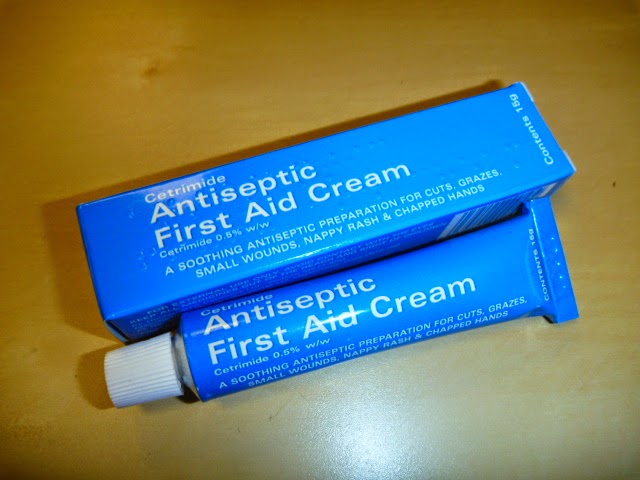
Antiseptic Cream. After cleaning a wound with water, this is good to prevent infection, keeping the wound clean. If this First Aid kit is used to treat others, or someone in the family is sensitive to the ingredients to the cream - it should be excluded.

Wound and Dressing closures. Washproof plasters to cover small cuts, Steri-Strips to close deeper wounds, safety pins and micropore tape to hold dressings fast in place.

Triangular bandages are great, and so versatile! You can make a head bandage, or sling from one! But, with slings, be careful with the paper type of bandage, they aren't so strong, so a fabric type may be better!

Face shield. Vital to prevent cross contamination when delivering mouth to mouth resuscitation (Rescue Breaths) to a casualty. We ensure we have these in our First Aid Kits, as well as on keyrings with our keys. One is always close to hand!

Gloves. Gloves are really important to prevent cross infection in both directions. Blood and other body fluids generally isn't the most pleasant of things to be in contact with, and more so, can contain some pretty nasty stuff such as viruses. Gloves are a quick and easy way to keep your hands free from all this whilst you treat a casualty.

Wound cleansing wipes. Alcohol Free. Great for cleaning a wound when away from water. You can gently, and under your own control, clean around a wound. Alcohol does have great cleaning properties, but when applied to a wound can hurt really badly, and also, can cause a reaction with a casualty. Sterile Water, as found on these wipes, will do just fine.

Assorted Dressings, Bandages, and pads. A dressing is often a bandage with a pad, whereas a bandage is a long piece of material, often woven for strength. There are many dressings / bandages, and each has it's own use. A Crepe bandage for example (Top middle) is elasticated, and this allows for swelling of the injured part, without cutting off circulation (Big problem). It's commonly used on joints, whereas other dressings can be used alone, and then bandaged over to prevent blood seepage.

Tough scissors & Tweezers. A tough pair of scissors helps cut through clothing and shoe laces etc. Tweezers are so important for removing small splinters and the such - But be aware, we don't remove bits of glass, or branches from people. That foreign object may be plugging a hole where without it's presence, a whole load of blood may flow out, and we really don't want that!
Other items for a First Aid kit may include a foil blanket (Mixed reviews on these), Sterile water (Eye wash) as well as a First Aid Booklet to help guide you in an Emergency.
If you're in the car, house, or office, extra levels of preparedness are required, and you will need to think about every potential incident, then aim off for it.
All the gear is great, but, without adequate training, it may be of little or no use in an Emergency, so, consider going on a First Aid Course.
Centric runs such courses for business and private groups alike. Check us out, we're here to help!
Monday, 29 December 2014
First Aid Winter Tips!
This morning, as I opened my front door, I uttered the words.... "It's here".
Clearing the snow off our vehicles, and sliding about the place, I was reminded about all the things we must remember as winter sets in.
Clearing the snow off our vehicles, and sliding about the place, I was reminded about all the things we must remember as winter sets in.
Winter first aid tips
From broken bones and sprains caused by slips, to the more extreme cases of hypothermia, there are lots of injuries that you or your loved ones may suffer as a result of icy weather.
A common injury is a sprain or strain which is when the soft tissues around the bone or joint become injured by violent or sudden movements. There may be pain and tenderness, swelling and bruising and difficulty moving the joint.
Remember the word RICE:
Rest the affected part;
apply an Ice pack(wrapped in a tea towel) for 10 minutes;
give Comfortable support using padding and a bandage and
Elevate it to help with pain and swelling.
Rest the affected part;
apply an Ice pack(wrapped in a tea towel) for 10 minutes;
give Comfortable support using padding and a bandage and
Elevate it to help with pain and swelling.
‘Sprains can be confused with broken bones (fractures), but a fracture generally requires more force. As well as swelling, bruising and pain, fractures can be suspected if you see a shortening, bend or twist in the limb. They tend to prevent the limb being used and a wound can appear where a bone may protrude. The body may also go into shock - a life threatening condition.
If you are unsure whether it is a sprain, strain or fracture that you are dealing with then always treat it as a fracture. Keep the affected part still, support it with lots of padding and send the casualty to hospital.
At this time of year we sadly hear about cases of hypothermia. This is when the body temperature drops below 35C and is recognised by shivering with pale, cold, dry skin and symptoms such as disorientation, apathy or irrational behaviour; impaired consciousness, slow and shallow breathing and a weakening pulse.
If you suspect hypothermia, replace any wet clothes with dry and re-warm the patient up slowly by giving them warm drinks and high energy foods such as chocolate.
Being Prepared
Prevention is better than cure!
Sprains, Strains and Breaks can be avoided, or limited by ensuring you have the appropriate footwear on for the conditions you will experience.
Wear sturdy footwear - even when driving, as you never know when or where you may be required to leave your vehicle.
If you are going to be outside a lot, think about wearing broken in hiking boots (Boots that have been worn in, so are comfortable). A good pair of boots will turn a break into a Strain / Sprain, and a Strain / Sprain into nothing.
Think about anti slip attachments for shoes that fit over for walking on snow.
Stock your vehicle with blankets, food, a torch, and a good first aid kit. Consider taking a flask of warm drink (Non alcoholic!). Ensure your mobile phone is fully charged, and people know where your going when you leave.
Keep a storage of food at home, help elderly relatives and friends by shopping for them, or arranging a delivery of supplies from retailers who deliver.
Being prepared also involves learning First Aid. There are many great organisations out there with voluntary schemes for training, such as the British Heart Foundation Heartstart scheme. HSE compliant First Aid Courses are also a good idea, which are more in depth, and you get an accredited qualification from it too!
For more information, go online to: www.centricuk.com
Monday, 1 December 2014
The meaning of life, Christmas, and Mental Health
Monty Python holds its own opinion!
"The meaning of Life" (What is) is a question which people have struggled with for millennia.
It can only be answered with opinion, as the meaning alters per individual. Those with faith could assign the meaning to a life of service to their God, others still, may not be able to answer the question fully, or be sent into a never ending spiral of being unable to answer at all.
For me, as an individual, the meaning of life, is to bring meaning to others, and this is done by offering compassion and care for those around me, and in turn this brings me comfort and joy. Seeing others succeed brings me enjoyment and satisfaction.
As we approach Christmas, many people start to wonder what the meaning of life could be. They question things they otherwise thought they knew. Add depression and loneliness into the equation, and it is understandable how some people may start to think that there is no meaning to life at all.
As an optimist, even things which I have little enjoyment from, or even totally dislike, I get some pleasure from, in knowing it will be over soon, but I can well appreciate what it feels like to have all optimism swallowed up.
But what of those people who dread this annual time of the year, sending them into 3 months of darkness. How do they get through this?
For most, they bottle up, shut up, and baton down the hatches. Perhaps relying on diagnosis, and medication to carry them through this, a shadow of their former selves.
But there are other ways:
"The meaning of Life" (What is) is a question which people have struggled with for millennia.
It can only be answered with opinion, as the meaning alters per individual. Those with faith could assign the meaning to a life of service to their God, others still, may not be able to answer the question fully, or be sent into a never ending spiral of being unable to answer at all.
For me, as an individual, the meaning of life, is to bring meaning to others, and this is done by offering compassion and care for those around me, and in turn this brings me comfort and joy. Seeing others succeed brings me enjoyment and satisfaction.
As we approach Christmas, many people start to wonder what the meaning of life could be. They question things they otherwise thought they knew. Add depression and loneliness into the equation, and it is understandable how some people may start to think that there is no meaning to life at all.
As an optimist, even things which I have little enjoyment from, or even totally dislike, I get some pleasure from, in knowing it will be over soon, but I can well appreciate what it feels like to have all optimism swallowed up.
But what of those people who dread this annual time of the year, sending them into 3 months of darkness. How do they get through this?
For most, they bottle up, shut up, and baton down the hatches. Perhaps relying on diagnosis, and medication to carry them through this, a shadow of their former selves.
But there are other ways:
- Finding a meaning to life is one. Activity, company, like minded people, all go a long way to taking the edge off it all.
- Being the meaning of life is another. Having pets who love unconditionally, rebuilding bridges with family and friends, supporting others, go a long way to taking the edge off it all.
- Seeing the meaning of life is yet another. Understanding there are others in similar positions, and working to help them, or asking for help from them. Companionship, Fellowship (In a Church sense), all goes a long way to taking the edge off it all.
Often, someone suffering from depression can present a difficult challenge to motivate. The causes are mostly situational, and don't always appear as they can change.
I can testify from personal experience that activity, and environment play huge parts in this, simple things like ensuring the house is clean and tidy, or fresh paint is applied, or the right kind of lighting and heat are in the house can make a big difference with instant effects, however, I understand cleaning the house is far from a simple thing if you are unwell. Reaching out for help can sometimes resolve this.
Company, support, and encouragement are another. People like to feel cared for, needed, and more so, wanted. Envelopment into community works well and can bring about change for those suffering, especially when they are engaged in activity.
Sadly, with Christmas heading straight for us - or us heading straight for it, there is little we can do apart from embrace it, even if we dislike it.
I can't suggest singing Christmas Carols at home, or in the street, on your own, but, as a group - well, it works for me!
If the situation does present itself to be unmanageable, then:
Be strong, know that there are those out there who would love the opportunity to have you in their lives, and will value you.
Be strong, know that there are those out there who would love the opportunity to have you in their lives, and will value you.
Reach out, there are people willing to listen to you, and offer support and advice where needed. Call the Samaritans on 08457 90 90 90 . They can even help signpost you to other agencies for help.
Over Christmas, the Salvation Army becomes more active than ever - support them with your time, or contact them for support.
Over Christmas, the Salvation Army becomes more active than ever - support them with your time, or contact them for support.
If you are ex forces there are specific charities that can provide support and assistance, such as SSAFA and the RBL. Do contact me directly and Ill signpost you myself.
Know of any other agencies or tips and tricks to help others? Please do comment below!
It's nearly January already, thankfully!
Monday, 24 November 2014
First Aid in the Workplace - The HSE regulations - Meeting and Exceeding. | My Local Services
We've discovered a great little forum. Check out our post on the HSE regulations, and discover what requirements your company should be achieving!
First Aid in the Workplace - The HSE regulations - Meeting and Exceeding. | My Local Services
First Aid in the Workplace - The HSE regulations - Meeting and Exceeding. | My Local Services
Wednesday, 12 November 2014
Face Masks - Would you do without? A question we're often asked!
We don't mix our words when we deliver First Aid training. We appreciate the gravity of actions the would be aid provider will be taking, so, it's no holes bared in preparation for a potential future emergency.
Our training material is reasonably graphic, and we 'tell it as it is'.
When we cover BLS (Basic Life Support) we introduce our students to face masks as part of their PPE, and the question always comes "Would you give Rescue Breaths without the device?"
Well, there sure is quite a variety of devices out there, from the Laerdal Style mouth and nose covering mask with one way valve, through to a paper filter sheet, with the latter being quite compact. We even supply one, with keyring holder, so there's no excuse to be without one, but, it doesn't take much imagination to realise, when you need something, it usually isn't there!
I (the author) have delivered Rescue Breaths without a mask, and it wasn't particularly nice, so that kind of answers the question - Yes, I would.
But there are times when the injury may demotivate me, for example, a gaping jaw injury, which incidentally may make delivering rescue breaths pretty ineffective anyways. Also the presence of body fluids would kind of put me off too.
The good news is, in these cases, we still deliver CPR, following the 'Hands Only' protocol.
To that end, there is no straight answer to the question really. I would take it case by case, and deliver the aid as appropriate, remembering the safe working principles.
Next course is about to start... £5 says Ill be asked the question in the next day or so!
Our training material is reasonably graphic, and we 'tell it as it is'.
When we cover BLS (Basic Life Support) we introduce our students to face masks as part of their PPE, and the question always comes "Would you give Rescue Breaths without the device?"
Well, there sure is quite a variety of devices out there, from the Laerdal Style mouth and nose covering mask with one way valve, through to a paper filter sheet, with the latter being quite compact. We even supply one, with keyring holder, so there's no excuse to be without one, but, it doesn't take much imagination to realise, when you need something, it usually isn't there!
I (the author) have delivered Rescue Breaths without a mask, and it wasn't particularly nice, so that kind of answers the question - Yes, I would.
But there are times when the injury may demotivate me, for example, a gaping jaw injury, which incidentally may make delivering rescue breaths pretty ineffective anyways. Also the presence of body fluids would kind of put me off too.
The good news is, in these cases, we still deliver CPR, following the 'Hands Only' protocol.
To that end, there is no straight answer to the question really. I would take it case by case, and deliver the aid as appropriate, remembering the safe working principles.
Next course is about to start... £5 says Ill be asked the question in the next day or so!
Monday, 27 October 2014
First Aid in the Workplace - What qualifications and how many? Lets make it easier!
One of the challenges business owners face is getting their heads round the mountain of information that applies to their business.
One thing business owners have in common, is that, they are very good at what they do - If they weren't, they wouldn't do it! Whether they operate a Glass manufacturing plant, a Garage, or a Corner shop, they are at the head of their game.
Most Barbers can't fly planes, and most pilots can't cut hair - and often it is the case, that getting to grips with matters that effect your business can seem like an unnecessary distraction.
So, they outsource. The pilot goes to the barber when he wants his hair cut, the barber goes to the pilots company when he wants to fly somewhere.
But, they at least need to know what kind of haircut they want, or where they want to fly to!
I can't cut hair, but what I can do is best direct you to the qualifications needed to remain compliant within the First Aid Regulations. I've done one better, I've simplified it all to save time!

Take a look at First Aid Training for more information. You'll go straight to the right page to be able to calculate what the requirements state.
As always, you can never be over qualified! Even if your business is in the low risk bracket, it is much better to be over qualified, and in all instances, it is good practice to hold a First Aid at Work certificate.
Why not like out Facebook Page, and keep informed about all the things we get up to! www.facebook.com/First.Aid.Training.Centric
One thing business owners have in common, is that, they are very good at what they do - If they weren't, they wouldn't do it! Whether they operate a Glass manufacturing plant, a Garage, or a Corner shop, they are at the head of their game.
Most Barbers can't fly planes, and most pilots can't cut hair - and often it is the case, that getting to grips with matters that effect your business can seem like an unnecessary distraction.
So, they outsource. The pilot goes to the barber when he wants his hair cut, the barber goes to the pilots company when he wants to fly somewhere.
But, they at least need to know what kind of haircut they want, or where they want to fly to!
I can't cut hair, but what I can do is best direct you to the qualifications needed to remain compliant within the First Aid Regulations. I've done one better, I've simplified it all to save time!
Take a look at First Aid Training for more information. You'll go straight to the right page to be able to calculate what the requirements state.
As always, you can never be over qualified! Even if your business is in the low risk bracket, it is much better to be over qualified, and in all instances, it is good practice to hold a First Aid at Work certificate.
Why not like out Facebook Page, and keep informed about all the things we get up to! www.facebook.com/First.Aid.Training.Centric
Friday, 17 October 2014
Owning a Defibrillator in the Workplace - Is it a good idea?
A Defibrillator is an electronic device which can deliver an electric shock through the body to correct a heart rhythm which is incompatible with life. Often, this is referred to as 'Restarting the Heart'.


The types of device available on the market today for private businesses and first responders are called AED's - Automated External Defibrillators, of which there are two types, fully automatic, and semi automatic.
Both types of device are computerised, and are designed to take the protocol decision making away from the rescuer. Typically, they follow a 1-2-3 process. 1 - Switch it on, 2 - Listen to the voice prompts / on screen messages, 3 - Press a Button if applicable.
Modern defibrillators do not make mistakes, they do not 'shock' people by accident, they are perfectly safe to use - even by people who have never ever touched or seen one before.
We carried out an experiment recently on several First Aid courses where AED use was not part of the curriculum. During the CPR phase on the manikins, we handed the student the AED Training device, and told them they had to use it.
They knew what an AED was for (It was part of the curriculum), they had seen pictures of one (a different model), they had even seen a live AED that each vehicle is equipped with in the company (Again a different model from the Trainer).
Each student, without fail, was able to apply the AED to the manikin, and follow the voice guidance - delivering a simulated shock.
Why have a Defibrillator in your workplace?
Quick access to a defibrillator is key to survival of a casualty experiencing a cardiac event where defibrillation would correct the rhythm.
Without a defibrillator on site, someone undergoing good CPR still stands a chance of survival, but that chance depreciates with every passing second whilst they wait for an ambulance to arrive.
A defibrillator increases the chance of survival from 5% (without) to 50% (with). Emergency medical care and further treatment is still required. (Source http://communityheartbeat.org.uk/ )
Although the Ambulance Service is targeted to respond within a certain time frame, the logistics of the world, circumstance, and indeed that time frame itself, is too long to wait in the case of a heart attack. You can rest assured that everyone is doing everything humanly possible to get help to you as quickly as possible - but it still isn't quick enough.
By having a defibrillator on site, and having people trained to use it, the chance of long term survival is greatly increased for the casualty.
Most businesses employ an alarm system for their premises - it protects the building, and its contents at night and on weekends when no one is there. Some businesses employ security guards, have cctv, and even tag their products to prevent loss by theft.
All businesses must comply with fire safety regulations, they must have fire extinguishers, adequate means of escape, and sometimes, they need a fire detection and alarm system too.
The same with having an appointed person, and first aid qualified staff. These are things that a company must have.
Yet, each year, the mirror newspaper reported in 2013, nearly 60'000 people suffer an out of hospital cardiac arrest, with an abysmal 8% survival rate. That's 55'200 people dying. ( link to article: Mirror Defibrillator Article ) I believe the statistic to be much higher for cardiac arrests, and this statistic possibly reflects those suffering a cardiac event, where defibrillation should have been an option.
For what is a reasonably low price, compared to CCTV, Security Guards, Burglar Alarms, etc, a Defibrillator can be purchased, or even leased from companies such as The Defib Shop - who have an outstanding record of service and product choice.
How much does it cost?
The cost is relative. If I were to tell you that in 6 months you would have a heart attack, and die with no aid to save your life, you'd possibly prepare to make your exit from this mortal shell as peaceful as possible. Sorting out your personal and business affairs so that they do not burden the next generation.
But, equally, you may notice I am not 'Death', I do not carry a scythe with me, and you could up your odds by ensuring you have a qualified first aider in the company, or better still, several, all in your office, and having access to a defibrillator. To that end, how much is your life worth?
The financial cost of an AED is surprisingly affordable, with a lower maintenance cost than ever before. A company can aim to pay well below £1000 to purchase an AED, and maintain it - some battery and pad options last up to 5 years, with 2 years being the average. Replacement pads are generally around £30 - £60 (Shelf life of approximately 2 - 3 years) and batteries are approximately £90 - £140. And don't forget, The Defib Shop has options to lease a device if that is more cost effective for your business.
Someone is likely to just steal it though
A whole range of alarmed cabinets are available. These devices are serialised, and good asset tracking can prevent the resale of these devices on the open market.
No one has had a heart attack at work before, it will never happen!
I certainly hope so, but imagine a situation where it does happen. Imagine it happening to you. We go about our lives in a continual state of risk, everything carries with it a potential danger, and we mitigate that danger by making preparations, such as ensuring the car we have has airbags, and crash protection, having fire extinguishers and first aid kits, wearing cycle helmets on bikes, eating more healthily to ward off ailments, and likewise, we should prepare for the risk of SCA (Sudden Cardiac Arrest) by having a defibrillator close at hand.
In summary...
We believe it is a great idea to have a defibrillator in the workplace (We have several). We believe defibrillators should be as commonplace as fire alarms, and wherever there are people, one should be no more than 1 minute away from them. The cost is inexpensive, there are means to obtaining a device if the initial outlay is beyond budget, and the long term investment is priceless to the person experiencing a cardiac event, and their family.
Need more information?
For Purchasing devices, we recommend www.defibshop.co.uk
For Purchasing devices, we recommend www.defibshop.co.uk
For Community Schemes for remote areas, we recommend www.communityheartbeat.org.uk
For First Aid Training, of course we recommend ourselves! www.centricuk.com
Find us online!
www.centriuk.com
On Facebook!
https://www.facebook.com/First.Aid.Training.Centric
On Twitter!
https://twitter.com/CentricUK
On Google!
https://plus.google.com/+Centricukfirstaid
www.centriuk.com
On Facebook!
https://www.facebook.com/First.Aid.Training.Centric
On Twitter!
https://twitter.com/CentricUK
On Google!
https://plus.google.com/+Centricukfirstaid
Wednesday, 15 October 2014
Brain Fog / Fuzzy Thinking - Simple Self Care
For some years, I, the author have been suffering with, under certain conditions, something called 'Brain Fog.
It's quite normal, and everyone experiences it at some point of their lives.
What is Brain Fog?
Brain Fog is a non medical term for a period where the thinking of a person is clouded. It is as difficult to describe as it is to think whilst experiencing a 'Fog' period.
The person undergoing the 'Brain Fog' feels as though their thoughts are muffled in a plastic bag above their head. On the outside, their appearance is often perfectly normal, but, their thoughts feel to themselves, inhibited, or clouded for reasons unknown.
Their decision making abilities don't appear to be affected for the majority of sufferers - it only seems that way to them, inside their head.
A 'Brain Fog' event can be debilitating, as the sufferer feels they cannot contribute effectively to their normal daily tasks, so isolation during a period of 'fogginess' is normal, or the overwhelming urge to go to sleep.
A sufferer will feel uncomfortable in telling another person how they feel, as they believe this condition may be related to Mental Health, which it may or may not be. The internal thoughts of their Mental Health being compromised may in turn lead on to Mental Health conditions / behaviour developing.
What Causes Brain Fog?
There are many potential causes, including;
Lack of Sleep
Lack of Real food / incorrect food
Medication / Treatment (Such as Chemotherapy)
Substance Abuse
Age
Sometimes 'Brain Fog' can be caused by underlying serious conditions however, such as Mercury Poisoning, Hormone Imbalance, Depression, Diabetes, Fybromyalgia, Thyroid conditions and Lymes disease.
How to treat Brain Fog
First of all - If you are unsure - You need to make an appointment to see your GP. Even if you feel you're sure, my advice is still to go and see your GP. This blog does not replace sound medical advice.
Treat the Cause
1)
Ensure you get sufficient sleep each night, without disturbance.
That means ensuring the temperature is right, there's enough air in the room, there's absolutely no light in the room (including the little blinking light of your mobile phone as it charges).
Develop a pattern. I.e. Go to bed at 10 each night, rise at 6. Don't go to bed at 3AM and rise at 2 PM.
The correct routine is easy. You just lie in bed each night, and eventually, a pattern will appear.
2)
Eat proper food - this means, if it's in a packet, don't eat it. Only eat food from the fruit and veg section of your grocery store, eat fresh, non processed meats. Eat fish. Drink plenty of water. Cut out the junk food and sweets.
3)
Discuss any medication you have with your doctor (Do not just stop taking medicine). Ask about Contraindications.
4)
Stop abusing substances. This includes Alcohol, tobacco products, coffee, Sugar.
5)
Go the the GP.
In most cases, Treatments 1 & 2 will resolve many of lifes issues. Try it.
Quick Fix
Having a 'Brain Fog' session right now? Try this.
If you are also Hungry - Eat.
If you are tired - Sleep.
These two options may not seem like options right now - but both work. Then treat the cause.
DISCLAIMER
This post is made from personal experience and research on the condition which is barely recognised. It is presented as is, and does not reflect the view of the company, or any training guidelines. In all instances seek professional medical help.
Find us online!
www.centriuk.com
On Facebook!
https://www.facebook.com/First.Aid.Training.Centric
On Twitter!
https://twitter.com/CentricUK
On Google!
https://plus.google.com/+Centricukfirstaid
It's quite normal, and everyone experiences it at some point of their lives.
What is Brain Fog?
Brain Fog is a non medical term for a period where the thinking of a person is clouded. It is as difficult to describe as it is to think whilst experiencing a 'Fog' period.
The person undergoing the 'Brain Fog' feels as though their thoughts are muffled in a plastic bag above their head. On the outside, their appearance is often perfectly normal, but, their thoughts feel to themselves, inhibited, or clouded for reasons unknown.
Their decision making abilities don't appear to be affected for the majority of sufferers - it only seems that way to them, inside their head.
A 'Brain Fog' event can be debilitating, as the sufferer feels they cannot contribute effectively to their normal daily tasks, so isolation during a period of 'fogginess' is normal, or the overwhelming urge to go to sleep.
A sufferer will feel uncomfortable in telling another person how they feel, as they believe this condition may be related to Mental Health, which it may or may not be. The internal thoughts of their Mental Health being compromised may in turn lead on to Mental Health conditions / behaviour developing.
What Causes Brain Fog?
There are many potential causes, including;
Lack of Sleep
Lack of Real food / incorrect food
Medication / Treatment (Such as Chemotherapy)
Substance Abuse
Age
Sometimes 'Brain Fog' can be caused by underlying serious conditions however, such as Mercury Poisoning, Hormone Imbalance, Depression, Diabetes, Fybromyalgia, Thyroid conditions and Lymes disease.
How to treat Brain Fog
First of all - If you are unsure - You need to make an appointment to see your GP. Even if you feel you're sure, my advice is still to go and see your GP. This blog does not replace sound medical advice.
Treat the Cause
1)
Ensure you get sufficient sleep each night, without disturbance.
That means ensuring the temperature is right, there's enough air in the room, there's absolutely no light in the room (including the little blinking light of your mobile phone as it charges).
Develop a pattern. I.e. Go to bed at 10 each night, rise at 6. Don't go to bed at 3AM and rise at 2 PM.
The correct routine is easy. You just lie in bed each night, and eventually, a pattern will appear.
2)
Eat proper food - this means, if it's in a packet, don't eat it. Only eat food from the fruit and veg section of your grocery store, eat fresh, non processed meats. Eat fish. Drink plenty of water. Cut out the junk food and sweets.
3)
Discuss any medication you have with your doctor (Do not just stop taking medicine). Ask about Contraindications.
4)
Stop abusing substances. This includes Alcohol, tobacco products, coffee, Sugar.
5)
Go the the GP.
In most cases, Treatments 1 & 2 will resolve many of lifes issues. Try it.
Quick Fix
Having a 'Brain Fog' session right now? Try this.
If you are also Hungry - Eat.
If you are tired - Sleep.
These two options may not seem like options right now - but both work. Then treat the cause.
DISCLAIMER
This post is made from personal experience and research on the condition which is barely recognised. It is presented as is, and does not reflect the view of the company, or any training guidelines. In all instances seek professional medical help.
Find us online!
www.centriuk.com
On Facebook!
https://www.facebook.com/First.Aid.Training.Centric
On Twitter!
https://twitter.com/CentricUK
On Google!
https://plus.google.com/+Centricukfirstaid
Thursday, 9 October 2014
Stroke - Know what to do
Stroke occurs when the blood supply to the brain is blocked. Part of the Brain becomes damaged. This often effects the persons appearance, speech, body functions, and sight.
Know how to recognise Stroke:
Think FAST:

Know how to recognise Stroke:
Think FAST:
- Face: If the face drops on one side
- Arms: If there is a loss of control or strength in the Arms
- Speech: If Speech becomes slowed or slurred
- Time: To call 999 / 112. This is an emergency, get help!
Talk to the person suffering Stroke, reassure them, comfort them. Keep Calm.
For more information, visit :
Wednesday, 8 October 2014
How do we beat Ebola?
Whichever way you look at it, the Ebola dilemma is raising a lot of unanswered questions, and worryingly, the speculation over what to do about the transience of it simply doesn't seem like affirmative action to prevent the spread.
The USA have announced screening at Airports, the UK is considering the same (At the time of writing) - but checks at Airports are simply no good - carriers in their early stages are non symptomatic - so could bring Ebola into their respective countries unwittingly to all concerned.
So perhaps some form of quarantine is required, as was maintained in New York Harbour in days gone by - however, the amount of people commuting in the 21st Centenary is far greater, making this impossible. Simply sit in any airport for several hours, and the daily passage from one terminal here alone is far greater than found at a port in the Victorian Era.
The only true way to beat Ebola is to nip it in the bud - attacking it's spread at source, however, it does seem that effected countries have been more or less left to fight it out alone.

The USA have announced screening at Airports, the UK is considering the same (At the time of writing) - but checks at Airports are simply no good - carriers in their early stages are non symptomatic - so could bring Ebola into their respective countries unwittingly to all concerned.
So perhaps some form of quarantine is required, as was maintained in New York Harbour in days gone by - however, the amount of people commuting in the 21st Centenary is far greater, making this impossible. Simply sit in any airport for several hours, and the daily passage from one terminal here alone is far greater than found at a port in the Victorian Era.
The only true way to beat Ebola is to nip it in the bud - attacking it's spread at source, however, it does seem that effected countries have been more or less left to fight it out alone.
The British Army recently announced they are sending 100 Army medics to Sierra Leone, and the USA has pledged even more boots on the ground.
Now lets not forget, Ebola isn't caught from the air, if it were, we would all be nearly dead by now, so sending troops, isolated from the main population, is reasonably safe. When there is contact, then they will be in full Protective Gear.
They will establish centres for administering the diagnosis and care of patients presenting with symptoms of Ebola.
This is a great start, and a move in the right direction - however, more is needed, and people are required to replace the troops.
How do we Beat Ebola?
Simple, we Educate, Control, and Eradicate cases.
1) Educate.
Let people know about it, tell them not to come into contact with the infected, give them new means to dispose of waste, and the dead. Provide with PPE.
1) Educate.
Let people know about it, tell them not to come into contact with the infected, give them new means to dispose of waste, and the dead. Provide with PPE.
2) Control
Marshall law, restrict movement, assign local authority leaders to enforce suspected case protocols.
3) Eradicate
Wherever cases present, they are isolated. The dead are disposed of swiftly without time for emotion or religious rights.
Bringing about all 3 sections are as tough as the last.
There is understandably a fear over Ebola, yet the education hasn't been sufficient to tempt people not to wash their dead, or to have physical contact with people showing symptoms, or to increase their personal hygiene. Instead we hear of Westerners sneezing, and being thought to be carriers - as if this is a westerners epidemic alone.
This is due to poor education on the part of the state, and potentially insufficient investment to educate, or the investment by donation being squandered.
As we prepare to put together a incident package, Ebola is very much in the forefront of our minds. It is our hope that it's spread ceases, and doesn't enter out country.
If it does, then we all need to be prepared, and thankful that we have the resources to manage Ebola containment with reasonable ease.
Video to follow of our preparations. Follow us on Facebook: www.facebook.com/First.Aid.Training.Centric
#Ebola
Saturday, 4 October 2014
Contents of a First Aid Kit, At home, and Abroad
It's important to have a well-stocked first aid kit in your home, so you can deal with minor accidents and injuries.Your first aid kit should be locked and kept in a cool, dry place, out of reach of children.Many people also keep a small first aid kit in their car for emergencies.
Your basic first aid kit
A basic first aid kit may contain:
- plasters, in a variety of different sizes and shapes
- small, medium and large sterile gauze dressings
- at least two sterile eye dressings
- triangular bandages
- crêpe rolled bandages
- safety pins
- disposable sterile gloves
- tweezers
- scissors
- alcohol-free cleansing wipes
- sticky tape
- thermometer, preferably digital
- skin rash cream, such as hydrocortisone or calendula
- cream or spray to relieve insect bites and stings
- antiseptic cream
- painkillers such as paracetamol (or infant paracetamol for children), aspirin (not to be given to children under 16), or ibuprofen
- cough medicine
- antihistamine tablets
- distilled water, for cleaning wounds
- eye wash and eye bath
It may also be useful to keep a basic first aid manual or instruction booklet with your first aid kit.
Medicines should be checked regularly to make sure they are within their use-by dates.
For every travel kit
- First aid kit
For minor injuries, use antiseptic with gauze squares, non-adherent dressings, bandages, fabric plasters, adhesive tape, scissors, tweezers and safety pins. You can buy bottles or sprays of standard antiseptic such as TCP from all major chemists, or get ready-prepared antiseptic wipes. A first aid kit may be useful if you're going off the beaten track or taking part in high-risk activities.
- Insect repellent
Mosquitoes usually bite between dusk and dawn, and are attracted to humans by our body heat, smell and the carbon dioxide we breathe out. Research shows that products containing the chemical DEET are the most effective insect repellents and are safe when used correctly. DEET products are available in sprays, roll-ons, sticks and creams. Your GP or travel health clinic will tell you whether the area you are going to is malarial and what protection is advised.
- Condoms
Condoms are recommended for everyone who is sexually active. Buy condoms with the CE mark on the packet. This means they have been tested to the high safety standards that are required in Europe. Condoms that don't have the CE mark won't meet these standards, so don't use them. Condoms can be damaged by oil-based products, such as suntan lotion, baby oil and lipstick. Heat can also cause damage, so store them in a cool, dry place. For more information on using male and female condoms, see How to use a condom.
- Antihistamines
Over-the-counter antihistamines can reduce itching and inflammation caused by allergies and insect bites. Antihistamines are available as tablets (oral antihistamines), creams (topical antihistamines) and nasal sprays. Antihistamines work by blocking the effects of a protein called histamine.
- Anti-diarrhoea pills
Anti-diarrhoea drugs, such as loperamide, can relieve symptoms of diarrhoea by slowing down the movement of bowel contents and sometimes by increasing water absorption from the gut. Loperamide can be taken once or twice a day, over a long period. However:
- Do not take anti-diarrhoea drugs if there is blood in your stools or if you have a high temperature (check with your pharmacist).
- Do not give anti-diarrhoea drugs to your child.
Travel in the developing world
- Rehydration sachets
Rehydration sachets help replace fluids and salts lost through diarrhoea, vomiting and too much sun. You can buy sachets of rehydration salts from your pharmacy and add them to water. They provide the correct balance of water, salt and sugar. Your doctor or pharmacist may also recommend rehydration drinks for your child, if you are worried they may become dehydrated. Do not use homemade salt or sugar drinks. Always consult your pharmacist.
- Mosquito net
A mosquito net is vital for sleeping in malarial countries. When buying a net, make sure it is impregnated with permethrin. Permethrin is a contact insecticide, which will kill insects landing on the net and, therefore, increase the net's effectiveness. Generally, nets will need to be impregnated again with permethrin after six months of use. Carry a small sewing kit so you can repair any holes that develop in the net.
- Anti-malarial drugs
Visit your GP, pharmacist or practice nurse four to six weeks before you leave to find out what malarial cover you'll need. They will also have up-to-date advice about the cover you need, and which strains of malaria are resistant to which drugs.
- Emergency medical supplies
Kits available from pharmacies, including sterilised and sealed syringes, sutures and needles, can be useful when visiting developing countries, where hospitals and dentists may not have properly sanitised equipment.
www.centricuk.com
www.centricuk.com
Wednesday, 1 October 2014
Ebola - Getting protected - Basic Advice
There is no effective antiviral treatment. Instead, treatment is supportive, and is directed at maintaining renal function and electrolyte balance and combating haemorrhage and shock.
Transfusion of convalescent serum may be beneficial.
Post-exposure treatment with a nematode-derived anticoagulation protein and a recombinant vesicular stomatitis virus vaccine expressing the Zaire Ebola virus glycoprotein have been shown to have 33% and 50% efficacy, respectively, in humans.
Recent studies have shown that small interfering RNAs (siRNAs) can be potentially effective in silencing Zaire Ebola virus RNA polymerase L, and treatments in rhesus macaque monkeys have resulted in 100% efficacy when administered everyday for 6 days; however, delivery of the nucleic acid still remains an obstacle.
IMMUNIZATION: None.
PROPHYLAXIS: None. Management of the Ebola virus is solely based on isolation and barrier-nursing with symptomatic and supportive treatments.
Based on the stark facts of Ebola, people are understandably very concerned. When another case arises, the press rush the news to print, making the spread seem wider than it is.
But what can we do to safeguard ourselves? What lessons can we learn from this recent outbreak, that may afford us better protection in the future?
Firstly, the mechanism of spread must be evaluated. Coming into contact with contaminated hosts, both dead and alive clearly is a major player in all of this. Isolation of those contaminated can help reduce the spread, but as we are seeing, with the 21st Century routine migration of travellers, suspected cases can arrive anywhere in the world, at any time.
A closed borders for entry policy is not economically viable, but, is plausible in a major outbreak to which containment is not possible.
In the mean time, local level migration control in countries worst effected (Such as Sierra Leone) is utilised to try and gain control.
We are left to trust decision makers that our best interests are catered for - but, systems fail, non symptomatic travellers, within the incubation period, can travel freely to home countries, residing with their families, before potentially infecting others nearby.
As citizens, it is our duty to do everything we can to protect our living environments around us, not just for neighbours, but also for ourselves, and our families.
Good levels of hygiene are critically important, washing of hands for example, using sanitising gel regularly, and particularly after making contact with another person.
Sanitising the entire work environment, phone systems, keyboards, light switches, door handles, and in our case, we maintain a staff toilet, and a customer toilet. Both are kept incredibly clean - but one is controlled over who uses it - all these things help cut down cross contamination.
Food eaten is prepared by the consumer only - no outside food is consumed wherever possible, all food prepared is cooked properly, or is within its own natural packaging (i.e. Banana's), the exterior of which is cleansed before unwrapping.
This is the daily routine, and although it sounds extreme, it falls into good practice, and prevents to the greater part, picking up lots of other bugs.
But, we cannot avoid all human contact in day to day life. We should not become recluse. It is important to engage with other people, and to do so in a familiar way without an eye of suspicion that could otherwise damage a relationship, be it professional or personal.
The game changer comes when cases become prevalent within our community.
A whole range of respiratory protective aids are available, from basic face masks through to CBRN respirators, which cost more, and are less available than the paper counterparts. Full CBRN suits are used by professionals, in conjunction with decontamination units and full assistive backup.
But without these resources, the lay responder, the worker, the citizen is most vulnerable to contamination, so more austere measures are required.
All the above sanitisation regimes should be used, as well as protecting from outside contact.
This extreme measure requires some forethought in preparation - without shopping for food, and supplies, we would soon become unstuck, without going to work, we would soon become financially void.
Good preparedness in home storage is needed, with a backup food supply of canned goods, and water, as well as toiletries, means the need to enter society for trivial means can be avoided.
All avoidance is impossible, and socially problematic, so keeping distance is appropriate instead. Avoiding physical contact, and sharing of food is an aide to preventing cross contamination.
Managing the dead - ensuring disposal of the body is prompt, and complying with local authority guidance is all important in preventing the spread too, and of course managing your own form of decontamination is vital.
Good resources to keep at home include:
Strong Surgical Gloves - Many pairs of Marigolds
Bin Bags
Face masks
Alcohol Gel
Camping toilets
Bottled Water
Tinned food of all varieties
Camping cookers
All of this seems extreme, but, up until quite recently, it formed part of the British education in preparedness for Nuclear Attack. After the dissolution of the communist government in Russia, it was felt the risk had been removed, however, although the risk may have changed, there is still the need for protection of one form or another.
Society has a Pronoia well established in its minds eye, always expecting the best outcome from the powers that be. This post in contrast may seem like Paranoia, but, the very same thing that may have attracted the reader, also encouraged the poster.
It takes one major event to change the thinking of others, but that major event may be one step too far for the survivability of many.
Further information is encouraged by visiting:
http://www.redcross.org.uk/en/What-we-do/Preparing-for-disasters/How-to-prepare-for-emergencies
https://www.gov.uk/government/publications/emergency-preparedness
https://www.gov.uk/browse/citizenship/government/emergencies-preparation-response-and-recovery
www.centricuk.com
https://www.facebook.com/First.Aid.Training.Centric
Transfusion of convalescent serum may be beneficial.
Post-exposure treatment with a nematode-derived anticoagulation protein and a recombinant vesicular stomatitis virus vaccine expressing the Zaire Ebola virus glycoprotein have been shown to have 33% and 50% efficacy, respectively, in humans.
Recent studies have shown that small interfering RNAs (siRNAs) can be potentially effective in silencing Zaire Ebola virus RNA polymerase L, and treatments in rhesus macaque monkeys have resulted in 100% efficacy when administered everyday for 6 days; however, delivery of the nucleic acid still remains an obstacle.
IMMUNIZATION: None.
PROPHYLAXIS: None. Management of the Ebola virus is solely based on isolation and barrier-nursing with symptomatic and supportive treatments.
Based on the stark facts of Ebola, people are understandably very concerned. When another case arises, the press rush the news to print, making the spread seem wider than it is.
But what can we do to safeguard ourselves? What lessons can we learn from this recent outbreak, that may afford us better protection in the future?
Firstly, the mechanism of spread must be evaluated. Coming into contact with contaminated hosts, both dead and alive clearly is a major player in all of this. Isolation of those contaminated can help reduce the spread, but as we are seeing, with the 21st Century routine migration of travellers, suspected cases can arrive anywhere in the world, at any time.
A closed borders for entry policy is not economically viable, but, is plausible in a major outbreak to which containment is not possible.
In the mean time, local level migration control in countries worst effected (Such as Sierra Leone) is utilised to try and gain control.
We are left to trust decision makers that our best interests are catered for - but, systems fail, non symptomatic travellers, within the incubation period, can travel freely to home countries, residing with their families, before potentially infecting others nearby.
As citizens, it is our duty to do everything we can to protect our living environments around us, not just for neighbours, but also for ourselves, and our families.
Good levels of hygiene are critically important, washing of hands for example, using sanitising gel regularly, and particularly after making contact with another person.
Sanitising the entire work environment, phone systems, keyboards, light switches, door handles, and in our case, we maintain a staff toilet, and a customer toilet. Both are kept incredibly clean - but one is controlled over who uses it - all these things help cut down cross contamination.
Food eaten is prepared by the consumer only - no outside food is consumed wherever possible, all food prepared is cooked properly, or is within its own natural packaging (i.e. Banana's), the exterior of which is cleansed before unwrapping.
This is the daily routine, and although it sounds extreme, it falls into good practice, and prevents to the greater part, picking up lots of other bugs.
But, we cannot avoid all human contact in day to day life. We should not become recluse. It is important to engage with other people, and to do so in a familiar way without an eye of suspicion that could otherwise damage a relationship, be it professional or personal.
The game changer comes when cases become prevalent within our community.
A whole range of respiratory protective aids are available, from basic face masks through to CBRN respirators, which cost more, and are less available than the paper counterparts. Full CBRN suits are used by professionals, in conjunction with decontamination units and full assistive backup.
But without these resources, the lay responder, the worker, the citizen is most vulnerable to contamination, so more austere measures are required.
All the above sanitisation regimes should be used, as well as protecting from outside contact.
This extreme measure requires some forethought in preparation - without shopping for food, and supplies, we would soon become unstuck, without going to work, we would soon become financially void.
Good preparedness in home storage is needed, with a backup food supply of canned goods, and water, as well as toiletries, means the need to enter society for trivial means can be avoided.
All avoidance is impossible, and socially problematic, so keeping distance is appropriate instead. Avoiding physical contact, and sharing of food is an aide to preventing cross contamination.
Managing the dead - ensuring disposal of the body is prompt, and complying with local authority guidance is all important in preventing the spread too, and of course managing your own form of decontamination is vital.
Good resources to keep at home include:
Strong Surgical Gloves - Many pairs of Marigolds
Bin Bags
Face masks
Alcohol Gel
Camping toilets
Bottled Water
Tinned food of all varieties
Camping cookers
All of this seems extreme, but, up until quite recently, it formed part of the British education in preparedness for Nuclear Attack. After the dissolution of the communist government in Russia, it was felt the risk had been removed, however, although the risk may have changed, there is still the need for protection of one form or another.
Society has a Pronoia well established in its minds eye, always expecting the best outcome from the powers that be. This post in contrast may seem like Paranoia, but, the very same thing that may have attracted the reader, also encouraged the poster.
It takes one major event to change the thinking of others, but that major event may be one step too far for the survivability of many.
Further information is encouraged by visiting:
http://www.redcross.org.uk/en/What-we-do/Preparing-for-disasters/How-to-prepare-for-emergencies
https://www.gov.uk/government/publications/emergency-preparedness
https://www.gov.uk/browse/citizenship/government/emergencies-preparation-response-and-recovery
www.centricuk.com
https://www.facebook.com/First.Aid.Training.Centric
Subscribe to:
Posts (Atom)